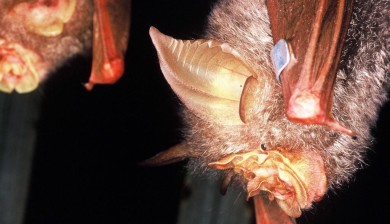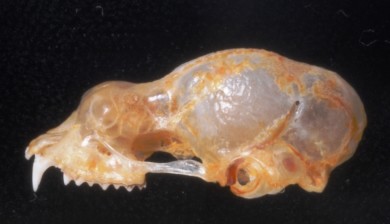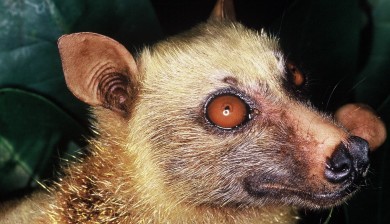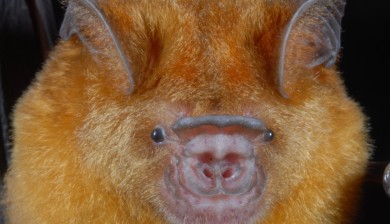
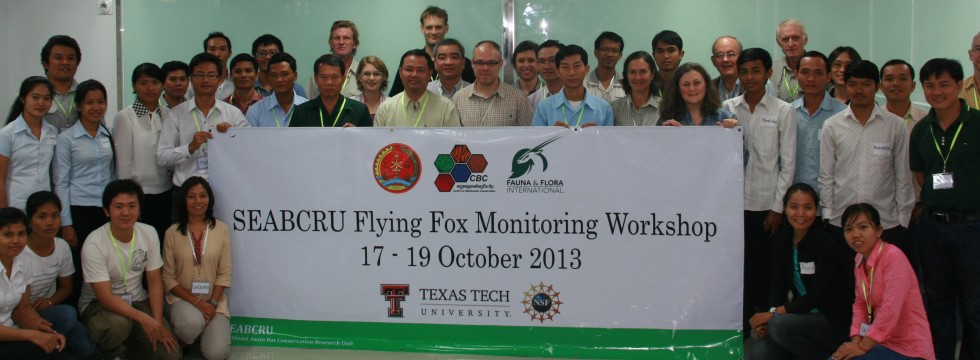

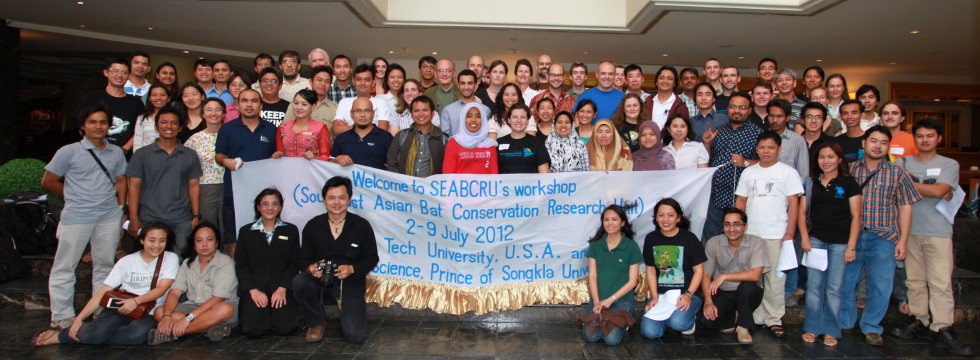
There are four two-day workshops, one for each of the SEABCRU research and conservation priorities: Flying Foxes, Cave Bats, Forest Bats, Taxonomy and Systematics. The workshops will run concurrently to allow participants to interact, and an exchange of ideas and findings among the workshops is scheduled for the second day.
OBJECTIVE: The main objective of the 2012 workshop is to bring together people with existing expertise and interest in the SEABCRU priority research and conservation areas to work together to:
PARTICIPANTS: Based on the workshop objective, participants should be citizens of a Southeast Asian country:
These are the criteria by which participants will be selected.
PLACES: There are 12 fully-funded openings for participants for each of the four workshops. Full funding includes all workshop costs, flights within SE Asia, accommodation and food. There is NO STIPEND available to participants. Competition will be high for the funded positions, so additionally there are three-five places available on each workshop for participants able to secure support from their institution. There is no charge for the workshop itself, be we anticipate that accommodation and food will be approximately US$170.
HOW TO APPLY: All applicants must complete the online application form. You may preview the application form questions by viewing the attached document.
DUE DATE: Applications must be received by 20th May 2012.
| [ ] | 40 Kb |
The first set of workshops will be in 7-8th July in Hat Yai Thailand.
More information coming soon.
Information on how to obtain published articles on bats of Southeast Asia will be coming soon.
The attached materials were developed for distribution at two sites in Vietnam: Kim Hy Nature Reserve and Ba Be National Park. They comprise an informative brochure/leaflet and calendar for each site.
Thank you to Neil Furey for sharing these with us.
| [ ] | 168 Kb | |
| [ ] | 206 Kb | |
| [ ] | 863 Kb | |
| [ ] | 356 Kb | |
| [ ] | 449 Kb | |
| [ ] | 494 Kb |
Materials developed by the Malaysian Bat Conservation Research Unit comprise a mixture of new materials and those adapated from existing activities. You can download as pdf, or, to enable you to adapt the scenarios to your situation, as word documents.
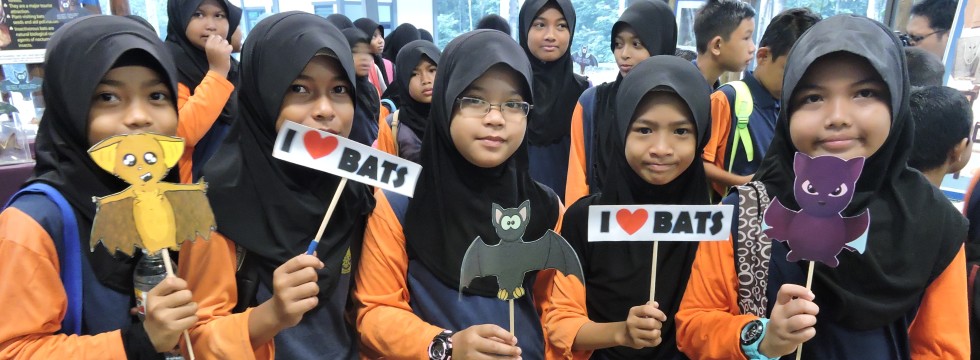
The Malaysian Bat Party Pack - a comprehensive guide for teachers, parents, educators to hold a fun but educational three-hour children's workshop (or Bat Party). The workshop is designed for childred aged 7-12, and the pack includes basic information about Malaysian bats, detailed descriptions of activities, how to make the relevant materials (templates inlcuded, suggested dialogue for facilitators, and tips on how to organize the event. The pack can be used in it's entirety to hold the complete party, or the activities can be individually integrated into existing outreach programs. Produced in 2005.
BATS Poster - Highlights the diversity of bats in Malaysia.
Bat Comic - Part of the Party Pack, but provided here separately aswell. It follows the story of an insectivorous bat called Gema and covers the importance of bats as pollinators, seed dispersers and agents of pest control. A crossword, word search and maze problem test comprehension of the issues. High resolution format available on request.
BATS Leaflet - a simple leaflet highlighting the diversity and importhance of bats, with a few basics on bat ecology and myths. Provided as two pages, but designed to be double-sided and folded into thirds.
Bat Math - explore bat biology and conservation through math exercises. Solutions and facilitator notes provided
Bat Math 1: A Natural Pesticide. Uses math to illustrate how insectivorous bats are important agents of pest control.
Bat Math 2: Tons of Food. Illustrates the quantities of food that bats need to eat to support their metabolism. Leads into a Natural Pesticide, or suitable for younger students.
Bat Math 3: Life Statistics. Shows how bat reproductive biology can lead to slow population recovery after disturbance.
Bat Math 4: Bats in Rainforests. Just how many bats are there in a rainforest? Based on trapping data at a research site in Peninsular Malaysia.
Bat Games & Activities - games and activities that explore aspects of bat biology and conservation. Get the blood and creative juices flowing!
Game 1: Bat-Moth. A classic game demonstrating how bats use echolocation to finding insect prey.
Game 2: Where's My Baby. A game illustrating how mother bats find their offspring in maternity roosts, using a combination of spatial memory, vocalizations and olfaction.
Activity: Camping Bat Style. A creative way to find out how some bats make tents from leaves.
Role Play Activity: Saving Batu Caves. For older students or adults, this is a role play activity to illustrate how different stakeholders perceive a conservation issue, specifically cave exploitation for limestone.
Activity: Bat Fruit Salad . How to put together a simple salad comprised of fruits pollinated and and/or dispersed by bats to provide both refreshment during activities and to illustrate the critical role that bats play as seed dispersers and pollinators.
Bat Signs and Projects - Catching and handling bats requires a lot training and should only be undertaken as part of a research program organized by an experienced scientist. BUT that doesn't mean that nature groups or students can't observe and learn about bats, and even design a project of their own. The following three projectes are suitable for students over 14 yrs old and adult naturalist groups. Each project starts simply, and the provides suggestions on how to develop the project over a longer time period. The projects require little equipment, although 'Project 1: Aerial hunters' is enhanced by the use of a bat detector.
Project 1: Aerial Hunters. A simple assessment of the diversity of insectivorous bats hunting in your neighbourhood.
Project 2: Finding Fruit Bats. Details how to look for signs of fruit bats foraging or roosting, and then develops investigations of diet.
Project 3: Monitoring Roosts. Describes a protocol for counting bats as they emerge from large, relatively permanent roost sites (like caves and buildings). Can be used to monitor populations over time.
| [Illustrates that insectivorous bats are important agents of pest control] | 85 Kb | |
| [Illustrates that insectivorous bats are important agents of pest control] | 115 Kb | |
| [Gema, an insectivorous bat, explains to us the importance of bats for pollination, seed dispersal and the control of insect pests] | 1181 Kb | |
| [ ] | 105 Kb | |
| [ ] | 157 Kb | |
| [A classic game demonstrating how bats use echolocation to find their prey] | 144 Kb | |
| [A classic game demonstrating how bats use echolocation to find their prey] | 178 Kb | |
| [Highlights the diversity of bats in Malaysia] | 1568 Kb | |
| [Estimates the abundance of bats in a rainforest based on trapping data. ] | 68 Kb | |
| [Estimates the abundance of bats in a rainforest based on trapping data. ] | 91 Kb | |
| [Basic introductory leaflet] | 680 Kb | |
| [ ] | 89 Kb | |
| [ ] | 128 Kb | |
| [Using math and life history characteris to understand why bat populations are so slow to recover after disturbance] | 286 Kb | |
| [Using math and life history characteris to understand why bat populations are so slow to recover after disturbance] | 239 Kb | |
| [Guide for a 3-hr workshop for 7-12 yr-olds] | 7604 Kb | |
| [Guide for a 3-hr workshop for 7-12 yr-olds. ] | 5614 Kb | |
| [A simple assessment of the diversity of insectivorous bats hunting in your neighbourhood] | 28 Kb | |
| [A simple assessment of the diversity of insectivorous bats hunting in your neighbourhood] | 50 Kb | |
| [Details how to look for signs of fruit bats foraging or roosting, and then develops investigations of diet] | 33 Kb | |
| [Details how to look for signs of fruit bats foraging or roosting, and then develops investigations of diet] | 63 Kb | |
| [A protocol for counting bats as they emerge from large, relatively permanent roost sites (e.g. caves and buildings)] | 27 Kb | |
| [A protocol for counting bats as they emerge from large, relatively permanent roost sites (e.g. caves and buildings)] | 42 Kb | |
| [For older student or adults, this is a role play activity to illustrate how different stakeholders perceive a conservation issue] | 186 Kb | |
| [For older student or adults, this is a role play activity to illustrate how different stakeholders perceive a conservation issue.] | 155 Kb | |
| [Illustrates the quantities of food that bats need to eat to support their metabolism.] | 83 Kb | |
| [Illustrates the quantities of food that bats need to eat to support their metabolism.] | 112 Kb | |
| [How do mother bats find their pups in busy maternity roosts?] | 131 Kb | |
| [How do mother bats find their pups in busy maternity roosts?] | 174 Kb |
We have 6 guests and no members online
This material is based upon work supported by the National Science Foundation under Grant No. 1051363. Any opinions, findings and conclusions or recomendations expressed in this material are those of the author(s) and do not necessarily reflect the views of the National Science Foundation (NSF).