Sephy Noerfahmy and Matt Struebig translated the newspaper articles cited in the article:
18 Sept 2010 - Bengamat [flying-foxes] blooming in Barito Timur –
(by Didin Rachmadin, Tamiyang Layang)
======================================================
Up to 60 individuals can be sold per day for 45 thousand rupiahs (US$4.5)
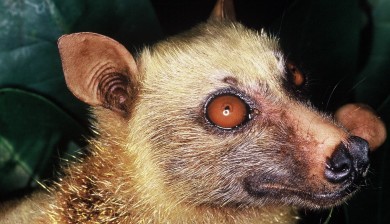
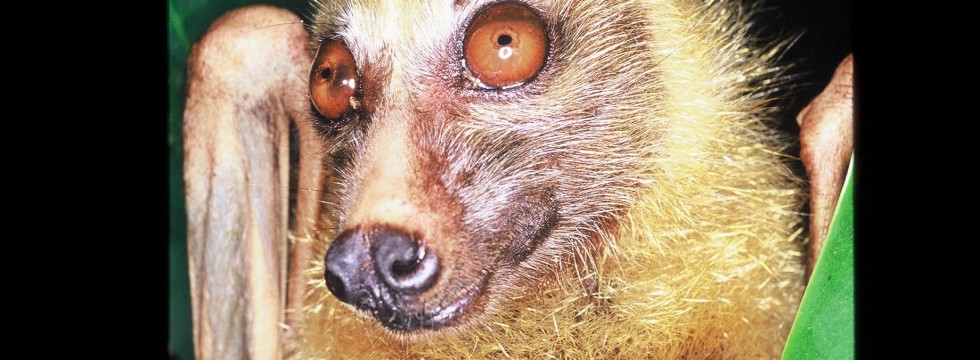
Kalong or Bengamat [local name for Flying fox] seems to be one of the favorite seasonal menu in Barito Timur [East Barito]. Even though it is not everyday menu in September local people usually hunt these "big bats" for food. This article is responding to this seasonal commodity of Barito Timur locals.
For local people, Kalong is not an ordinary snack but often the favorite snacks. Kalong or Bengamat is hunted target species in Barito Timur district especially in the settlement of Tamiyang Layang.
One local seller in Achmad Yani road, Asiang (age 40), said that August to October are kalong hunting seasons. “I hunt this species by going to several forest areas, such as Tangkiling forest, Kasongan near Palangka raya, he said". Asiang also said that kalong is not only consumed as a food but also as medicine, for example people use the bile as asthma medicine.
Local people process this species in different ways, such as frying it, roasting it, boiling it or even eating it raw. Asiang said that during this season he can sell up to 60 individuals in one day. There are variations in price starting from Rp30,000 (US$3) for the dead kalong until Rp45,000 (US$4.5) for the live one. Many Tamiyang Layang people like this bengamat meat.
Asiang not only sells Bengamat in Tamiyang layang but also in several places, such as Bentot, Hayaping, Ampah, Pasa Panas, Buntok and his home town Palangkaraya
________________________________________________________________
3 Nov 2010 - The peril of kalong hunting –
(By Godwin Limberg)
================================================
Highest Kalong hunting in Buntok and Tamiyang Layang
Puruk Cahu,
People have to reconsider to hunt bengamat or kalong, the local name for "big bats" (flying foxes) in Central Kalimantan because it will increase the occurrence of epidemic disease and lower the production of economical important commodities, said conservationist Godwin Limberg.
There are two reasons, why this massive hunting is dangerous. First, bengamat carry Hendra and Ebola virus that previously caused deaths to cattle and humans in Malaysia, Bangladesh, and Australia. If bengamat roosting trees are far from local settlements the risk of spreading the virus is low, but the risk is increased if bengamat are handled with hands during hunting or selling. He also said Australian and Javan researchers found that bengamat found in Kalimantan are infected by Nypah virus. Second, people believe consuming this bat can cure asthma even though there is not any medical proof. Bengamat also give ecological services because they pollinate forest trees and economical commodities trees, such as durian (Durio spp.), petai (Parkia speciosa), and rubber (Hevea brasiliensis).
From a recent study, Godwin said that Bengamat poaching happens in all part of Central Kalimantan with the highest intensity concentrated in Palangka Raya, Buntok and Tamiyang Layang. Therefore he hoped that people reduce or stop hunting these bats so that the wild population can keep growing, to reduce the spreading of infectious disease and get benefit from nature.
"This approach will reduce risk of spreading disease and at the same time keep the economical benefits from the ecosystem, from pollination and seed dispersal by bengamat". As an example, Godwin said that the Southeast Asian durian trade was valued at US $120 million. This put bengamat as an important commodity that can increase local economy even though this hasn’t been realized by the community. Sometimes a bengamat population decrease in one area can affect fruit production near them and can give negative impact to the local economy. This also affects local community health because there will be less nutritious fruit that they will afford.
For your information, Godwin has a background as a trainer in agricultural counseling and training for national park development, community involvement in natural resource management, research on CSR, conflict management of natural resources, climate change issue and spatial planning at district level.
4 Nov 2010 - Residents are not worried about bats -
======================================
People say that meat is tasty and can cure asthma.
Conservationist and sustainable development expert Godwin Limberg’s statement, that the decline in bat populations may increase the risk of disease transmission does not bother the local Buntok community. Especially for people who like bat meat.
The fact that bats are vectors of dangerous diseases such as Hendra and Nipah viruses does not bother the local community though both viruses have caused mortality in domestic animals and humans in Malaysia, Bangladesh and Australia.
Rani, a resident who consumes fruit bat meat stating that paing (the local name for flying fox) bile can be used as asthma medication. He added that although there has been no medical proof the treatment of asthma using Paing bile has been part of Dayak community traditional medication. According to Rani, in his experience of eating paing meat he has never been exposed to dangerous diseases.
The youth who has a degree in social science added that Paing meat is tastier than other meat and its processing was not too difficult – just need to add salt.
The most important factor in processing Paing meat is to clean it completely. Parts that need to be cleaned include the black leather found on the paing’s nape because it is not good for health, said Rani sharing his experience.
Meanwhile, another resident, Nanie says the same thing that they have to trust the efficacy of paing bile as asthma medication. South Barito people who rarely eat meat also believe in the efficacy of bile paing as asthma medication.
13 Nov 2010 - Peaking kalong trade in Buntok -
=================================
The buyers are from Amuntai, The bile is use for Asthma medication
Kalong or bengamat, the local name for flying foxes, is a commodity in demand for Buntok's community, especially the Maayan tribe. They said that Kalong meat is delicious compare to other domestic animal meat. One of the buyers is Hajj from Amuntai, South Kalimantan. What do they buy it for? This article will reveal.
Buntok residents, especially Mayaan, consider paing flying fruit-eating animals as savory meat, said Mayaan citizen Atak Rani. "To process the meat it only needs salt and flavorings, because one thing that makes it delicious is the blood."That's why bat meat should be in fresh condition, "he said adding," bile for both asthma medication. "Temporary paing vendors in the area of Kepasturan Jalan Panglima Batur Buntok, Sabi confirmed that the blood of bats is also used as a spice in cooking.
He also said, every day at least 30 paing individuals are sold. Sometimes a day 150 individuals can be sold for a price per head of around Rp50,000 (US$50). Paing consumers are not only Maayan people, but also Manado people and Hajj from Amuntai, South Kalimantan. "Hajj from Amuntai buy at least 15 individuals. They buy it for medication purpose because they believe the efficacy of bat bile for curing asthma. They even send bile to Jakarta.
Sebi said that the price of fruit bats is quite expensive because of high demand and it must be imported from Tangkiling Palangka Raya and Timpah Kapuas. Paing trade increases with the coming of summer fruit, "Paing are currently not widely available in the South Barito because the fruit season has not occurred there yet". According to her, Paing foods include the forest fruits called kasiau and nato. Besides those two fruits kalong also eat durian flowers, she said.
Meanwhile, one of the Muslim people from South Barito shared his childhood experience about khasiat kalong bile. He said that he used to have asthma but it was cured after his father gave him kalong bile. The chairman from one of Muslim parties, Nahdatul Ulama, Drs. H. Suryadi Kurnain said that from an Islamic point of view it is primary to have alternative medicine that is allow by the religion. But the disease continues to happened despite all the effort that have been done to cure it. As for kalong bile, it can be use as an alternative if there is no other way to cure it.
________________________________________________________________
This material is based upon work supported by the National Science Foundation under Grant No. 1051363. Any opinions, findings and conclusions or recomendations expressed in this material are those of the author(s) and do not necessarily reflect the views of the National Science Foundation (NSF).